Industry History
Flex vs Coworking: Why One Industry Has Two Names
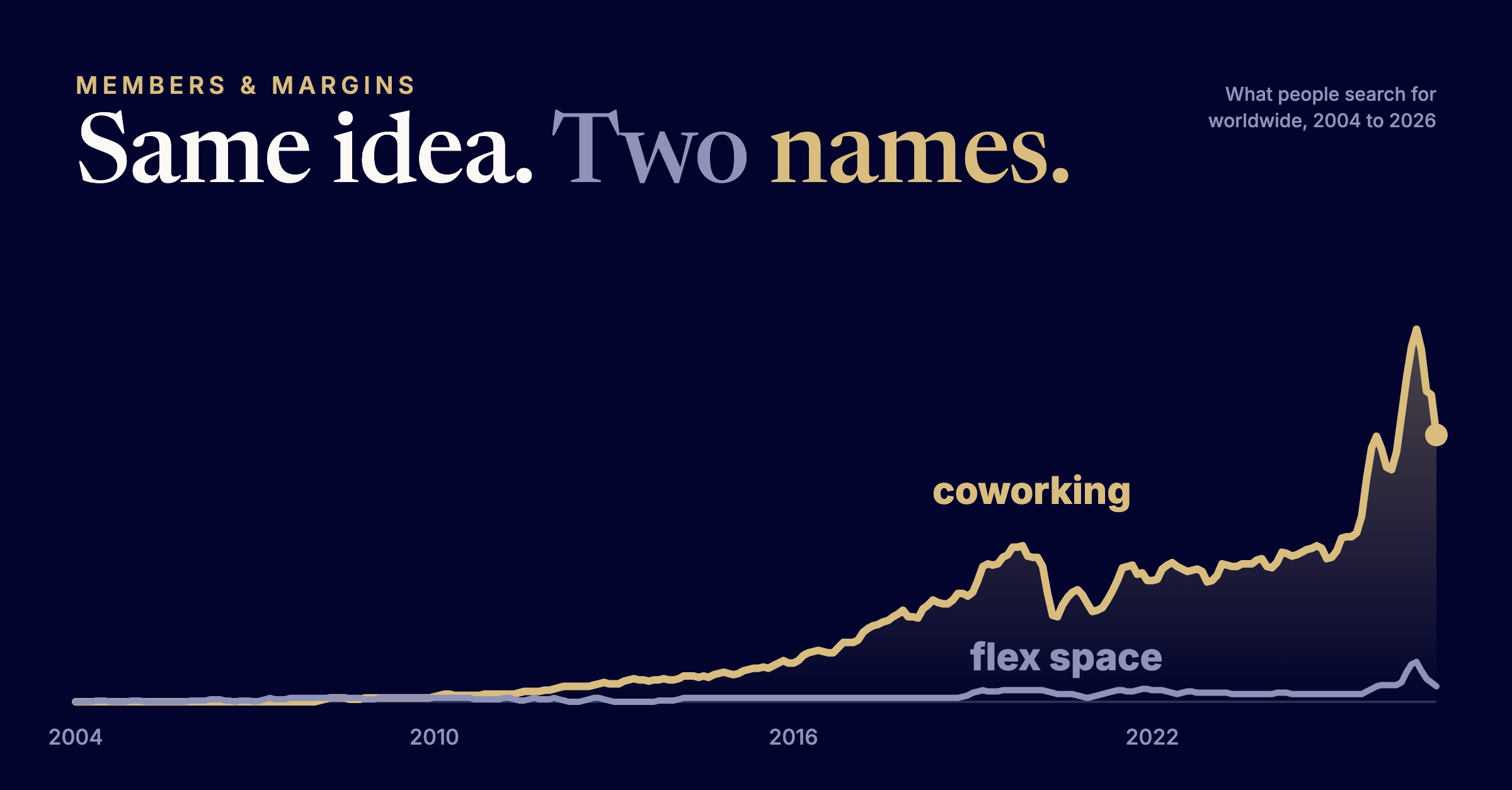
Brokers, operators and trade bodies moved to “flex” between 2014 and 2019. In books and in Google searches, coworking never stopped growing, and flex barely registers.
In this article
Two names for one idea
Half the industry says coworking. The other half says flex. They are describing the same thing, and they mostly do not read each other.
We recently traced the industry’s most quoted number back to where it started. This piece does the same for its two names: where each came from, who carried it, what each one measures, and why the argument between them keeps coming back.
Where “flex” came from
Three words, three origins, and only one of them was ever about people.
flex
A building type
Office at the front, warehouse at the back, adaptable to whatever a tenant did. In Google Books the phrase “flex space” peaks in the early 1990s, in this sense.2
1990s
flexible office
The serviced-office industry’s word
Regus, in its 2000 annual report: “flexible office space accounting for less than 2% of the global office market.”3 The same year a landlord described HQ Global as “the global leader in flexible workspace solutions.”4
2000
coworking
A room and the people in it
San Francisco, 2005. A programmer who wanted company while he worked rented a room in a community center two days a week and “gave it a new name: coworking.”25 Never a real estate category. Nobody who used it was describing a lease.
2005
By its 2009 report, Regus called itself the “world’s largest provider of flexible workspace,”5 and in 2011 the U.S. serviced-office trade body, founded in 1986 as the Executive Suite Association, renamed itself the Global Workspace Association.6 The serviced-office industry had its vocabulary a decade before anyone needed an umbrella. Coworking came up underneath it, fast, on its own, and with a different word for a different thing.
The rename
Coworking arrived with its own name, and in 2013 commercial real estate’s own research arm was still using it. Within a year the brokers began calling it something else. Ten documents, six years. The why comes after.
- 2013NAIOP Research FoundationDevelopers’ association
Publishes “Workplace Innovation Today: The Coworking Center,” on “coworking centers, which have grown from just one in 2005 to 781 in 2013.”28
The year before the rename. The word “coworking” appears 190 times in the report. “Flex” never names the category once.
coworking
- 2014CBRE and GenesisBroker
“landlords partnering with flex space providers (co-working centres or serviced office providers)”7
The rename begins. Coworking is placed inside “flex space” as one kind of provider.
flex space
- 2015Knight FrankBroker
“Flexible offices are another growth area, particularly collaborative offices.”8
Coworking described without being named.
flexible offices
- 2016JLLBroker
“Seismic shift in demand for co-About that hyphen. Inside the coworking community, “co-working” has been a sore point for about as long as the word has existed. From outside it looks like pedantry. It is not. The hyphen is how the word comes out when it was learned from a report rather than a room, and the people who built the rooms can hear it. When a movement loses the right to name itself, it holds on to what is left, and sometimes what is left is one character.working space - up to 30% of a corporate portfolio will comprise flexible space by 2030.”1
The demand is still called co-working. The measurement is already called flexible space. The industry settled on the second.
co-working, measured as flexible space
- 2017SavillsBroker
Launches Workthere to find “flexible, co-working and serviced office space.”9
A broker builds a business line on the umbrella, with coworking as one item under it.
flexible, co-working and serviced
- 2018ColliersBroker
“Hence the phrase ‘flexible workspace’ to encompass both.”10
A broker says out loud why: one word for serviced offices and coworking together.
flexible workspace
- Cushman & WakefieldBroker
“Coworking or flexible offices are becoming a staple in buildings.”11
Both words in one title, used as if they were the same thing.
coworking or flexible offices
- CBREBroker
Launches Hana, for “flexible office space solutions.” Coworking is one of its three products.12
Coworking becomes a line item inside a flex business.
flexible office space solutions
- 2019UK Business Centre AssociationTrade body
Renames itself the Flexible Space Association, June 20.13
The trade body takes the word as its name.
flexible space
- WeWorkSEC filing
“We pioneered a ‘space-as-a-service’ membership model.”14
The best-known coworking company goes public without the word.
space-as-a-service
Nobody announced a rename. It happened one report at a time.
It happened inside the institutions that count space, broker it and finance it, and each step had a practical reason: one term for every short-term office product is easier to measure, compare and sell. Nobody in that chain was wrong to want it.
It was never unanimous. In July 2019 one operator told a London conference, “Coworking used to be a buzzword. Now it’s the leading word.”15 Two months later CBRE titled its national report “Let’s Talk About Flex.”16 Same year, two names.
The two vocabularies, side by side
One idea. Two names.
flex
Named by the people who count the space.
The serviced-office industry, 2000. The brokers, 2014 to 2019.
coworking
Named by the people who built it.
Community builders, 2005. Still the word the public uses.
| Coworking | Flex | |
|---|---|---|
| Came from | The community builders who started it | The serviced-office industry and the brokers |
| Names | The people, and what happens between them | The contract and the terms |
| Brings to mind | Shared tables, open desks, members | Private offices on short terms |
| Measured in | Members, retention, how the room feels on a Tuesday | Occupancy, revenue per desk, share of the building |
| Who says it | Community builders, independent operators, members | Owners, brokers, lenders, large platforms |
The operators who prefer “flex” are describing their product, not a philosophy. On a CBRE podcast in 2024, the chief executive of The Office Group said coworking “literally means you are in these massive open plans,” while what his company mostly sells is private offices on flexible contracts. “Flex is a better term,” he said, and then, “I think we still have to find the right word.”17
I think flex is accurate. It’s a substrate. It’s beneath the surface.
Jamie Hodari, chief executive of Industrious, on coworking, in the same conversation, 202417
The objections come in two kinds. Community builders say the word was chosen by people who have never spent a Tuesday in one, and that it leaves out the only thing that makes a space work: what happens between the people in it. Managed-office operators say the opposite problem: “flex” has become “a catch-all term for such a wide range of workspace products” that it no longer tells a buyer much.18 One side says the word holds too little. The other says it holds too much.
The argument surfaces every time someone calls for more professionalism and economic clarity, and someone else asks since when real estate became the measure of whether coworking has grown up. Both questions are fair. They are being asked from different seats.
What the public calls it
Step outside the industry’s own reports and the answer is not close.
What people search for, 2004 to October 2026
“Flex” won inside the industry’s paperwork. “Coworking” kept the public. Neither replaced the other, which is why both are still in use and why the argument keeps coming back. It is not a disagreement about what the thing is. It is two groups of people describing the half of it they can see.
The price of being counted
Coworking did not wait to be discovered. It spread on its own momentum, from one borrowed room in 2005 to thousands of spaces worldwide within a decade, with no broker, no lender and no trade body behind it, and nobody counting but the industry’s own magazine.26 That speed is what made commercial real estate look. And once it looked, the institutions that renamed coworking were the same ones that gave it capital, institutional landlords and a line in the research. The category is many times larger for it: more than nine thousand locations in the United States alone today, on a listing site’s broader definition.27
The price of being counted was the word. An institution can only name what it can measure. A lease term, a share of a building and a revenue per desk all have a vocabulary. A Tuesday on which strangers become colleagues does not. The community manager is on the spreadsheet, as a salary. The community is not on it anywhere, which means the only way a ledger can see community is as a cost. So the measuring institutions named the part that fit their forms, and the part that did not fit went unnamed.
What happened to organic
Coworking is not the first word a movement coined and an institution took over. The closest parallel is on every supermarket shelf, and the two stories run step for step.
organic
- Coined by
- Farmers, 1940
- Redefined by
- The U.S. government, 2000
- Argued down by
- The industry’s trade association, 2005
- Still used by
- Every shopper
coworking
- Coined by
- A programmer, 2005
- Renamed by
- Brokers and trade bodies, 2014 to 2019
- Measured by
- What a lender can count
- Still used by
- Everyone who searches for it
Step by step, with the dates:
Coworking is in that decade now. The useful question is not which side is right. It is whether a space can be fluent in both vocabularies at once, because the institutions are not leaving, and neither are the people who built the communities.
Why the argument is worth having
Because the name picks the yardstick. Call a space flex, and it is measured like real estate: occupancy, term, the share of the building, what a lender will credit. Call it coworking, and it is measured the way a community is: who comes, who stays, who they met, and whether the room works.
Read the same space as
- OccupancyMembers
- Counted per desk, per monthForty businesses behind one door
- TermRetention
- Month to month reads as riskWho comes back after the first month
- Share of the buildingThe community
- One floor of six, inside the safe shareWhat happens between the people, which nobody sells
- What a lender creditsA Tuesday
- The income, at a discount or at zeroWhether the room is alive at nine
A space that only works on one yardstick usually does not last. The rent has to be paid, and the members have to want to come back. The spaces that have been open longest tend to be the ones where someone was fluent in both.
The middle ground
The middle ground is not a compromise between the two words. It is three things each side has to stop believing.
If you build the community
Three shifts
You cannot put a number on community.
Retention is community, as a number.
Members stay because of the people. Measured month by month, that is the one thing about your room a lender can finally read.
The landlord does not get it.
The landlord has a date.
The rent is due whether the room is alive or not. A lease is a promise with a date on it, and the date does not care about Tuesday.
We are not real estate.
You are the building’s front door.
Companies arrive on a desk, grow, and take a lease upstairs. Count the graduations. That is your value in the owner’s language.
What you bringThe demand itself, and the premium members pay over a bare office.
If you own the building
Three shifts
Coworking is an amenity.
Community is the product.
It is what members pay the premium for. The people paid to tend it are its cost of goods, the way a kitchen is the cost of a restaurant.
If it cannot be measured, it is not there.
If you do not measure it, you will never finance it.
Retention, graduations to leases, waiting lists: all countable. The lender will not change first. You can.
Month to month is risk.
Month to month is the product.
Short terms are what members are buying. The rent still arrives, because they come back, and that is managed in the room, not on the lease.
What you bringThe building, the capital, and the permanence that lets a Tuesday keep happening in year ten.
Why is the middle ground necessary, rather than nice? Because neither side is leaving. The institutions that count space are not going to stop counting it, and the people who build communities are not going to stop building them, so a space that speaks only one language is choosing to be misunderstood by half of the people it depends on. An owner who cannot hear the room will fund the wrong things. A community that cannot read the ledger will lose its room when the lease comes up.
The industry will go on using both words, and it should. One names what the people are doing. The other names what the building is being asked to do. Neither is wrong, and neither is the whole thing. A space that can say both, and mean both, is the kind that is still open in year ten.
Frequently asked questions
Where did the term "flex space" come from?
In U.S. commercial real estate, flex space first described adaptable buildings that combine office with light industrial or warehouse use. Google Books shows the phrase at its most common in the early 1990s, in that sense. The office-services meaning came separately, from the serviced-office industry, which was using "flexible office space" by 2000.
What is the difference between flex space and coworking?
In the industry's own usage, flex is the umbrella for any office taken on short, flexible terms, including serviced private offices, managed offices and coworking. Coworking names something else: people working side by side, and the community that forms between them. It can happen in an office building, a coffee shop, a library or a house.
When did "flex" replace "coworking"?
It did not, outside the industry. Brokers, trade bodies and large operators adopted "flex" and "flexible workspace" between roughly 2014 and 2019. In Google Books and Google Trends, coworking kept growing through 2026 and the flex terms stayed near zero.
Why do some operators prefer "flex"?
Because it describes the contract. As one large operator put it in 2024, coworking literally suggests large open plans, while most of what they sell is private offices on flexible terms.
Why do some operators object to "flex"?
Two different objections. Community builders say the word leaves out the people, and what happens between them, which is the only reason the space works. Others say it has become a catch-all so broad it no longer tells a buyer what they are getting.
Sources
- JLL, "Workspace, reworked" release, October 12, 2016 (via MarketScreener / Publicnow)
- Google Books Ngram Viewer, "coworking, co-working, flexible workspace, flex space, flexible office," English, 1990-2022
- Regus plc, Annual report and accounts 2000, chairman's statement (February 26, 2001)
- Site Selection Online Insider, "The Work Anywhere, Anytime Office Writ Large: $1 Billion HQ-Vantas Merger Closes," week of July 3, 2000
- Regus plc, Annual Report and Accounts 2009 (March 22, 2010)↩
- Office Business Center Association International release, PR Newswire, November 8, 2011↩
- CBRE and Genesis, "Fast Forward 2030: The Future of Work and the Workplace," 2014, p. 60
- Knight Frank and NGKF, "Global Cities: The 2016 Report," October 2015
- CoStar News, "Savills launches in flexible office sector," February 22, 2017
- Colliers, "The Flexible Workspace Outlook Report 2018: APAC," p. 3
- Cushman & Wakefield, "Coworking and Flexible Office Space: Additive or Disruptive to the Office Market?," August 2018
- CBRE, "CBRE Launches Service Offering to Meet Growing Demand for Flexible Space Solutions," October 31, 2018
- Origin Workspace, "Origin Workspace supports the voice of the flexible workspace industry," August 7, 2019
- The We Company, Form S-1, August 14, 2019
- Allwork.Space, "Hotels, Buzzwords, And Pessimism: 6 Highlights From Coworking London Conference 2019," July 2, 2019↩
- CBRE Research, "Let's Talk About Flex: The U.S. Flexible Office Market in 2019"↩
- CBRE, "You Might Think: Why flex workspace is thriving despite the headlines" (podcast transcript), January 23, 2024↩a ↩b
- Allwork.Space, Robert Schogger, "Has The Workspace Industry Outgrown The Term 'Flex?'," August 18, 2026↩
- Google Trends, "coworking," "flex space," "flexible workspace," worldwide web search, 2004 to October 2026
- California Certified Organic Farmers, "Our History"
- Federal Register, "National Organic Program," final rule, 65 FR 80548, December 21, 2000
- Harvey v. Veneman, 396 F.3d 28 (1st Cir. 2005); Congressional Research Service, RS22318, "Harvey v. Veneman and the National Organic Program: A Legal Analysis," 2006
- Organic Trade Association statement via ProfNet Wire, November 17, 2005; Certified Naturally Grown, FAQ; Real Organic Project, Pilot Program
- ASPCA, organic labeling public memo (ORC International survey, October 2013), April 10, 2014
- Brad Neuberg, "The Start of Coworking (from the Guy that Started It)," Coding in Paradise
- Deskmag, "2500 Coworking Spaces, 4.5 Per Day," March 4, 2013 (Deskwanted census as of February 1, 2013)↩
- CoworkingCafe (Yardi), "U.S. Coworking Industry Report Q3 '26," October 26, 2026↩
- NAIOP Research Foundation, Andrea P. Foertsch, "Workplace Innovation Today: The Coworking Center," December 2013
Members & Margins
The people and the business of the coworking model.
Ideas, stories and research for anyone who wants to understand both the members in the room and the margins that keep it open. Free.