Brokers
How Listing Brokers Get Paid on Flex
What does a listing broker actually earn when an owner fills a floor with flex instead of a lease? The answer is not in any one deal. It is in the paperwork.
In this article
The exclusive is written around one event
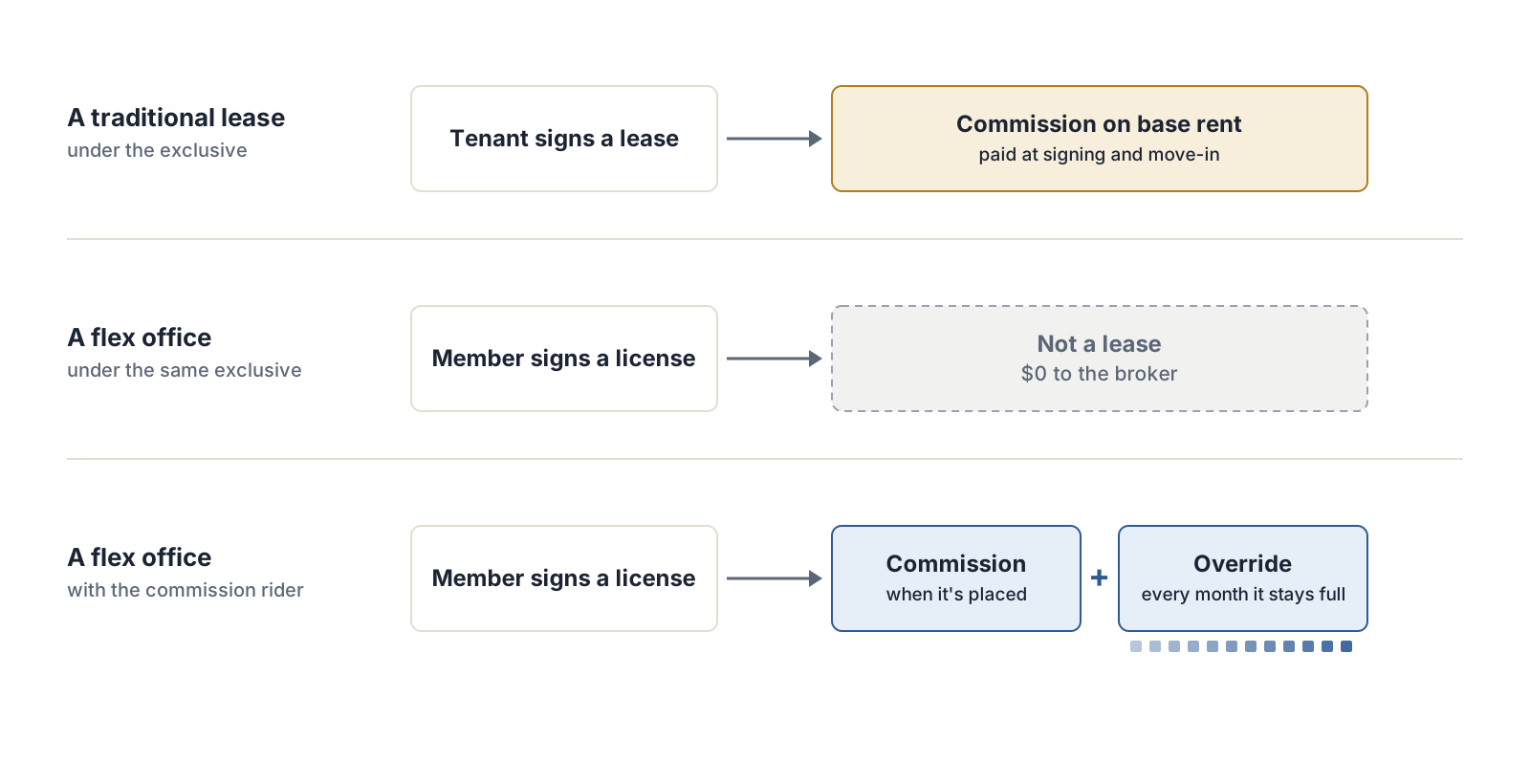
Read a standard office exclusive closely and you find the whole economy of the job hanging on a single moment. The broker earns a commission when a lease is fully signed, the first month’s rent is paid, and the deposit is in. The commission is a percentage of the base rent, year by year, across the term.
Everything in the document points at that moment. The marketing, the reports, the tail, the co-broke split. One tenant. One lease. One check, paid in two halves.
Now put a flex floor inside that document.
The offices are licensed, not leased. A license is not a lease. It says so, usually in its own words, so nobody confuses the two later.
So when an owner turns a dark floor into sixty private offices and fills them, the exclusive the broker signed simply doesn’t see it. No lease was executed. No base rent exists to take a percentage of. The broker who walked that floor for a year earns nothing on it, and the agreement is working exactly as written.
It was never the broker’s attitude
For years the explanation has been that brokers don’t believe in flex. That was never the real reason. The paperwork never told them how they’d be paid, so the rational move was to leave it off the list.
Flex isn’t a broker problem. It’s a document problem.
And document problems have document answers.
The forms already left room for it
The standard listing forms brokers sign every week already expect the compensation section to change from deal to deal. Some literally offer a box to tick: see the attached commission rider.
So the answer doesn’t have to be a new contract. It can be one more page, in the language brokers already use, attached to the agreement they already have.
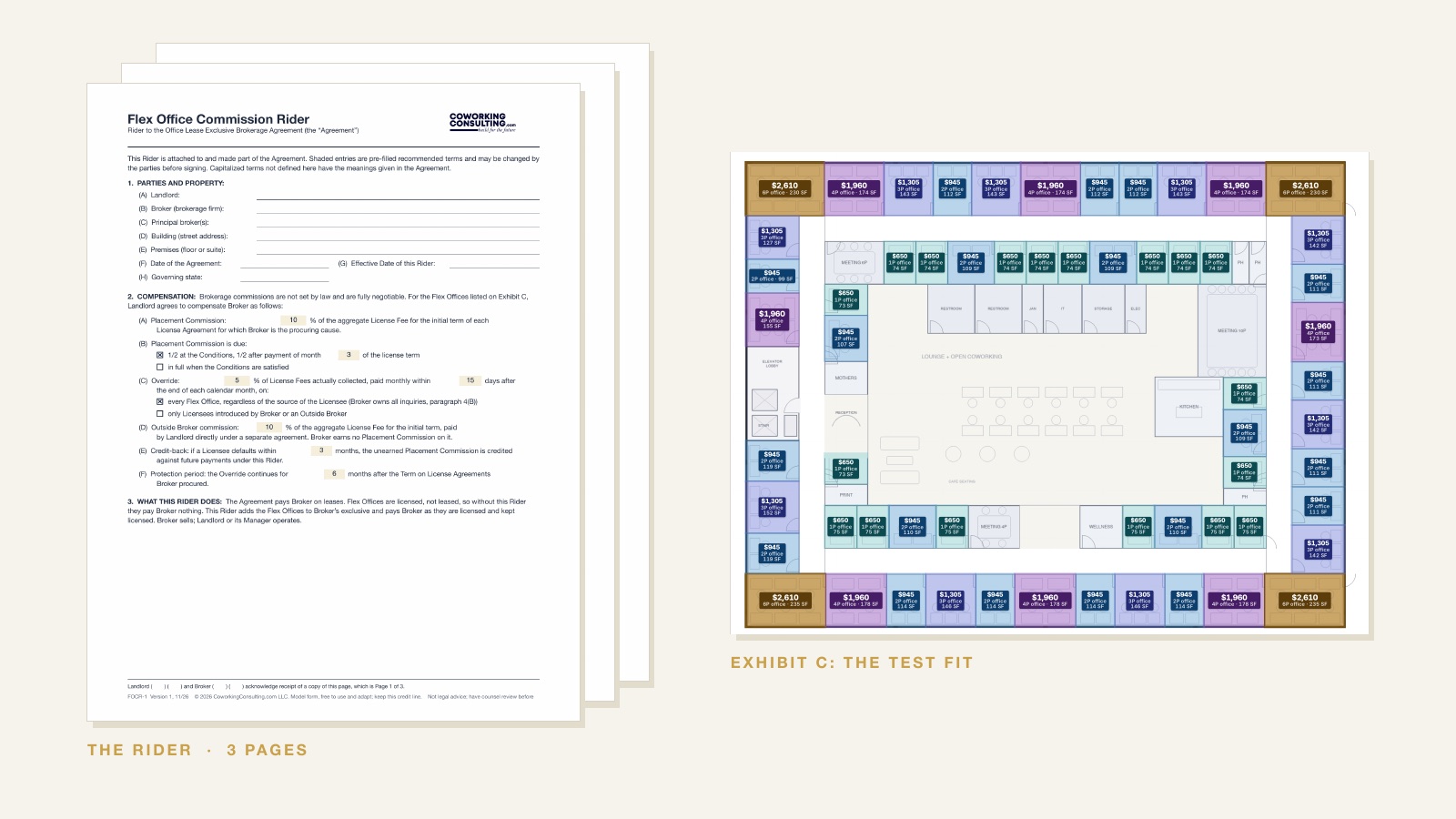
That page now exists: the Flex Office Commission Rider, a free model form from CoworkingConsulting.com.
What one page changes
It adds the offices to the broker’s exclusive. Not the floor, waiting for one tenant. The offices, every one of them, listed with its monthly rate.
It pays the broker the way the market already pays for flex placements: a percentage of the contract on every office the broker places. On a twelve-month license for a one-person office at $650 a month, that’s a $780 commission at 10%, on terms the operator world already uses.
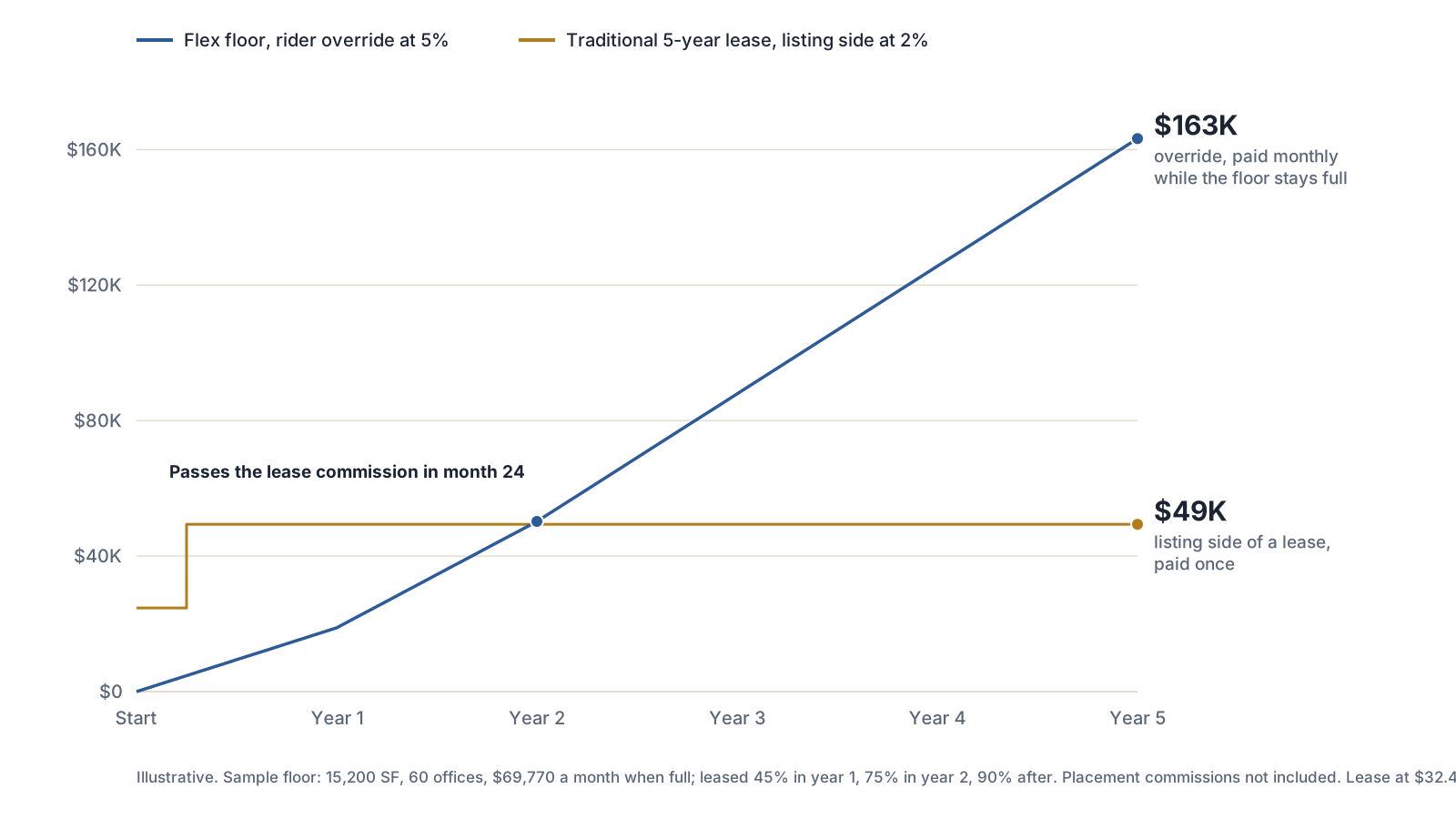
And it pays an override on every office that stays full, month after month, whoever found the member. On a sixty-office floor at ninety percent, a 5% override is roughly $3,100 a month. Illustrative, from a sample floor. But it’s the first time the listing side has had a reason to care about a flex floor after the ribbon is cut.
Why an owner would sign it
A flex floor needs someone who owns the sales. Leads go cold when nobody’s name is on the follow-up. Usually that someone is a salary, and it starts before the revenue does, paid in full while the floor is still mostly empty.
The rider hands that job to the broker the owner already trusts, and pays for it only as offices fill. The owner still runs the space. The broker sells it. Selling stops being a fixed cost and becomes a share of what’s actually collected.
The bridge was always a payment term
Owners who build flex rarely arrive through their listing broker. That has usually been read as resistance. It reads better as a missing page.
The broker and the owner want the same thing: the floor full, and kept full. The lease aligned them for ten years at a time. Flex broke that alignment, not because anyone stopped caring, but because nobody wrote down how the person who fills the floor gets paid for filling it.
Write it down, and the relationship comes back. Not one check at signing. A share in the floor staying full.
Where it fits, and where it doesn’t
This is for the floor an owner decides to run, alone or with a manager. If an operator signs a lease for the floor, the broker is paid the normal way, and the rider steps aside.
It’s a model form, not legal advice. Every state treats licenses a little differently, and an owner and broker should have counsel read it before they sign.
Take it
The rider is free. Use it, change it, attach it to your exclusive. Keep the credit line on it, so the next broker can find where it came from.
The one thing it can’t do on its own is fill in its schedule. Every office, its size, its rate. That’s what a Flex Revenue Test Fit produces, and it’s why the two were built to go together.
Get the Flex Office Commission Rider, free, from the Downloads on the Insights page.
Frequently asked questions
How does a listing broker get paid when an owner runs a flex floor?
Under a standard office exclusive, usually not at all. The exclusive pays a commission when a lease is signed, and flex offices are licensed to members rather than leased. A commission rider fixes that by adding the flex offices to the broker's exclusive and paying a commission on each office placed, plus an override while the floor stays full.
Is a coworking or flex office membership a lease?
Usually not. Members sign a license or membership agreement, and model office license forms state that a license is not a lease and does not create a landlord-tenant relationship. That difference is why a lease-based listing agreement does not reach flex offices.
What commission do brokers earn for placing a client in flex space?
Large flex operators commonly publish a referral rate of about 10% of the first year of membership fees, paid on the full membership rather than base rent alone. Renewals, where paid, are typically a small percentage.
What is the Flex Office Commission Rider?
A free one-page model form by CoworkingConsulting.com that attaches to a broker's existing exclusive. It adds the flex offices to the exclusive, pays a placement commission on each office the broker places and an override on collected office fees, and carries a schedule of every office with its monthly rate. It is not legal advice; have counsel review it before signing.
Members & Margins
The people and the business of the coworking model.
Ideas, stories and research for anyone who wants to understand both the members in the room and the margins that keep it open. Free.