Developer Strategy
Why Developers Should Add Coworking: Flexible Leasing Drives Higher Yields
Integrating professional flexible office and coworking layers allows commercial real estate landlords to optimize density, capture diversified revenue streams, and command premium rental yields.

In this article
Underwriting Context. This page translates typical flexible workspace marketing hype into a disciplined real estate underwriting framework. It details the five financial yield pillars that make adding a coworking layer a highly profitable developer strategy.
What to do next. Review the five yield pillars below to analyze how flexible leasing alters submarket absorption. Use our feasibility scan tool to underwrite actual occupancy and pricing targets for your property.
The Yield Delta: Conventional Lease vs. Flexible Ecosystem
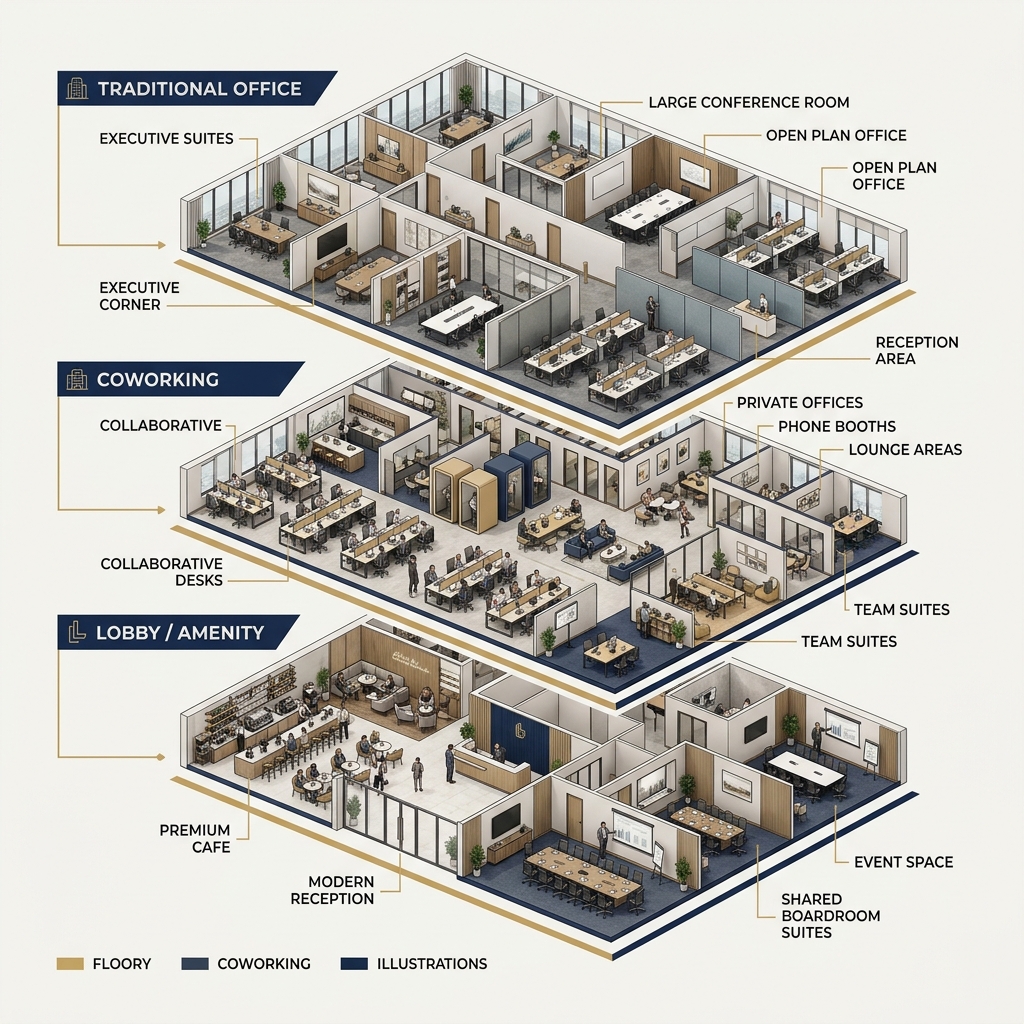
Underwriting the economic spread between rigid traditional leases and a dynamic, high-density operational workspace.
Conventional Lease Tenancy (Conventional Model)
Space leased as a fixed, low-density static commodity.
Spatial Density: ~200 SF / Person
- Lease Commitment: Rigid 5 to 10 Year Terms
- Average Density: 200 SF per Occupant
- Revenue Stacking: 0% (Single Source Rental)
- Operational Complexity: Low (Passive Landlord)
Average Annual Yield. $35.00 / SF
Flexible Operating Ecosystem (Operational Model)
Space activated as a high-density, multi-channel service.
Spatial Density: <100 SF / Person
- Lease Commitment: Agile Monthly or 12-Month Licenses
- Average Density: Under 100 SF per Occupant
- Revenue Stacking: 80%+ (Suites, Desk Pass, Mail, Rooms)
- Operational Complexity: High (Active Hospitality Operations)
Weighted Average Yield. $65.00 to $85.00+ / SF
Building Composition: Layering Revenue Streams
By incorporating an active flexible operating layer into the commercial asset stacking plan, landlords maximize the total return of the property structure. Placing traditional corporate leases above highly activated, dense coworking floors and ground-level hospitality assets achieves multiple financial objectives:
- Ground Level Hospitality: Pre-lease boardrooms and premium cafes to activate common areas.
- Middle Floor Coworking: Create high-density, multi-tenant spec workspaces to drive spatial margins.
- Top Floor Corporate: Command premium lease pricing by feeding high-growth tenants into standard floors.
The Five Financial Yield Pillars of Flexible Workspace
Integrating flexible office layers into commercial office portfolios changes the core revenue equation of the property. When properly structured, the model functions on five economic yield drivers:
Moving from Space-as-a-Commodity to Space-as-a-Service
The core error landlords make when incorporating coworking is treating it as a simple spatial amenity. A beautiful room with desks and coffee is not a business strategy. To unlock maximum yields, developers must treat flexible workspace as an active operational service layer.
This transition requires integrating standard operating procedures, integrated SaaS booking tools, dynamic keyless access control, and Hospitality-focused operational teams. When these elements align, they create a high-margin operating asset that captures high-yielding, premium, hourly demand that traditional office leases completely miss.
Evaluating the Developer Feasibility
Before allocating capital or altering floor plans, real estate developers must answer critical strategic questions to de-risk the investment:
- Local submarket demand: What specific typologies (private suites, hot desks, corporate spaces) will local occupiers actually pay a premium for?
- Product mix optimization: What is the ideal ratio of private offices to open coworking desks to maximize average revenue per usable square foot?
- Operating structure: Should ownership white-label the brand to capture 100% of the operational margins directly, or structure a joint-venture revenue-share agreement with an established operator?
- Technology integration: How will access control, booking software, CRM, and billing gateways synchronize to reduce operational staffing costs?
Frequently asked questions
Does flexible office represent a higher operating risk for landlords?
While operational models carry higher monthly revenue variability than flat-lease tenancy, this risk is mitigated by layering diversified product offerings (like virtual mail, meeting rooms, and corporate team suites) and using structured management agreements to align landlord-operator incentives.
How does adding a coworking layer affect building financing?
Capital markets increasingly view an integrated, professionally managed flex layer as a positive, risk-reducing differentiator. Institutional lenders support the model when the flex space represents a disciplined portion of the building (typically 10-20%) and is backed by a conservative, market-calibrated underwriting pro forma.
What is the most efficient operating structure for developers?
Most asset owners select either a joint-venture management agreement (aligning incentives with a specialized operator) or build a proprietary white-label brand to capture 100% of the operational margins directly, avoiding expensive third-party leasing commissions.
Members & Margins
The people and the business of the coworking model.
Ideas, stories and research for anyone who wants to understand both the members in the room and the margins that keep it open. Free.