Market Trends
2025 Coworking Trends: Management Agreements, Niche Markets, and Service Ecosystems
The commercial real estate landscape has shifted. Landlords and flexible workspace operators are abandoning traditional lease structures in favor of aligned, profit-sharing management agreements, hyper-specialized niche community structures, and transaction-based service ecosystems.

In this article
Pillar 1: The Structural Shift to Asset-Light Management Agreements
The prominent development of 2025 is the transition of coworking operators from traditional tenants into professional service managers. During economic cycles, fixed lease liabilities frequently lead to operator insolvency, which disrupts building operations and hurts asset valuations. Profit-share management agreements resolve this vulnerability by aligning the incentives of the asset owner and the flexible office manager.
In a standard management agreement, the operator acts as a fee-earning service provider rather than a lessee. The financial structure typically breaks down as follows:
- Base Operating Fee: The operator receives a fixed base fee, usually ranging from 6% to 8% of gross revenue, to cover management systems, licensing, and central operational costs.
- Performance Incentive Fee: The operator participates in a profit-sharing pool, typically capturing 15% to 20% of net operating profit once the landlord’s priority yield is met.
- Landlord Capitalization: The landlord funds 100% of the initial capital expenditures, including tenant improvements, premium furniture packages, and brand-compliant technology infrastructure.
This structure guarantees operator solvency by removing lease liabilities from their balance sheet. For the landlord, it transforms vacancy exposure into an operational partnership, allowing them to capture substantial premiums above conventional market rent rates.
Interactive Model Comparison
Compare the financial dynamics, risk profiles, and operational boundaries of a Traditional Fixed Coworking Lease against a 2025 Joint-Venture Management Agreement.
Fixed Office Lease
A rigid tenant-landlord relationship with fixed rental payments and high operator counterparty risk.
- Capex Funding: Operator Funded
- Rent Structure: Fixed Monthly Cost
- Operator Fee: N/A (Keep Upside)
- Lease Liability: High Exposure
- Landlord Alignment: Adversarial
- Risk Profile: High Solvency Risk
- Average Landlord Yield: $28.00 / SF
Management Agreement
A modern, collaborative profit-share joint venture aligning landlord capitalization and operator systems.
- Capex Funding: Landlord Capitalized
- Rent Structure: Profit-Share Pool
- Operator Fee: 6-8% Base + 15-20% Profit
- Lease Liability: Zero Liability
- Landlord Alignment: Fully Collaborative
- Risk Profile: Protected Solvency
- Target Landlord Yield: $65.00 - $85.00 / SF
Pillar 2: Hyper-Specialization and the Rise of Niche Communities
As the flexible workspace sector matures, generic, multi-tenant coworking spaces are facing intense pricing pressure and commodity positioning. In response, operators in 2025 are focusing on hyper-specialization, building distinct communities tailored to specific professional demographics or industries.
By shifting from generic space to hyper-specialization, operators can capture premium margins. Specialized hubs serve target verticals with dedicated spatial layouts and amenities:
- MedTech & Life Sciences: Shared wet lab spaces, compliant clean room environments, and specialized regulatory consulting access.
- Creative & Media Production: State-of-the-art podcast studios, professional photography cyc walls, soundproof editing bays, and design-focused rendering workstations.
- Climate-Tech & Sustainability Hubs: Clean energy laboratories, shared material libraries, and carbon-conscious operational footprints attracting mission-aligned capital and green enterprise teams.
Specialized operators report a 25% to 40% premium in average desk pricing and a substantial reduction in annual membership churn. Enterprise teams are willing to pay significant premiums to position their departments in creative environments that foster strategic collaboration.
Decoding the Joint-Venture Structure
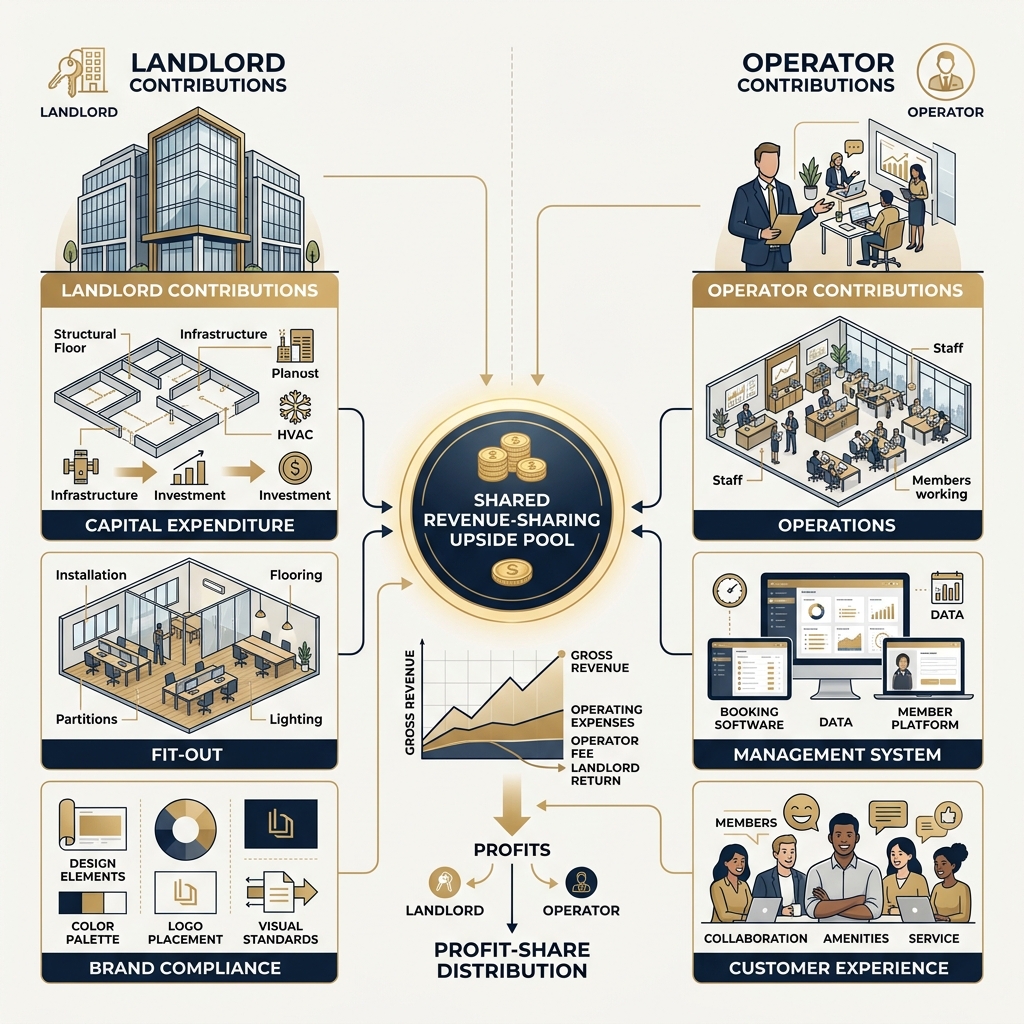
A successful management agreement aligns the strengths of the capital partner and the operational specialist. By structuring contributions and profit distributions systematically, the partnership optimizes long-term asset performance:
- Landlord Contributions: Provides high-quality physical real estate, funds the workspace fit-out, handles the structural envelope, and ensures brand-standard spatial design compliance.
- Operator Contributions: Implements proprietary booking software, manages on-site staff, coordinates targeted marketing, and curates high-end hospitality services.
- The Upside Pool: Disburses gross revenues through a structured cash waterfall, prioritizing operator base management fees, building operating expenses, and landlord capital amortization before splitting the remaining operational profits.
Pillar 3: Spaces as Comprehensive Service Ecosystems
The third major trend in 2025 is the transition of flexible real estate from physical square footage rentals into transactional service ecosystems. Modern operators look past desk counts to focus on maximizing customer lifetime value by layering on demand-based transaction channels.
A resilient flexible workspace ecosystem layers multiple high-margin revenue streams on top of monthly desk fees. This includes on-demand meeting rooms equipped for high-performance virtual boardrooms, wellness programs including integrated meditation chambers and fitness packages, and professional F&B offerings like building-wide lobby cafes. Additionally, operators provide advanced technology integrations, such as customized AI-driven booking systems, automated occupancy analytics, and dedicated digital membership packages for hybrid teams.
By establishing these transaction layers, operators can double their average revenue per rentable square foot. Landlords benefit from this model because the presence of a professional, amenity-rich workspace ecosystem increases rental rates and leasing velocity across the rest of the building’s conventional floors.
Frequently asked questions
How does a management agreement protect a landlord during market downturns?
Unlike traditional leases where operator insolvency causes sudden building disruption, a management agreement keeps the operating entity solvent. Since the operator has no fixed rent obligation, they can reduce expenses during downturns. The landlord continues to collect all operating profits, avoiding sudden lease defaults and costly tenant repositioning cycles.
What capital expenditure is typically required from a landlord?
A landlord is responsible for structural fit-out, premium furniture, branding, and standard technology infrastructure. This capital contribution is typically modeled as a capital improvement, which amortizes over the agreement term and is recovered from gross revenues before operational profits are distributed.
Are specialized niche spaces harder to lease than generalist coworking?
While niche spaces target a specific professional demographic, they command significantly higher user loyalty, lower churn, and stronger pricing power. Generalist spaces face intense pricing competition, whereas specialized spaces build highly integrated professional communities that resist commoditization.
Members & Margins
The people and the business of the coworking model.
Ideas, stories and research for anyone who wants to understand both the members in the room and the margins that keep it open. Free.