Space Planning
Optimal Private Office Mix in Flex Conversion: Maximizing NOI
How real estate asset owners optimize spatial geometry, balance desking ratios, and capture stable high-margin cash flows during commercial office to coworking conversions.
In this article
Strategic Underwriting. This study outlines the core mathematical and operational frameworks commercial landlords utilize to configure rentable space during a conversion. It details why over-allocating open desking destroys property value.
Product Allocation. Analyze actual square footage benchmarks and layout strategies below. Use our feasibility scan to calculate the high-performing layout configuration for your property’s submarket.
Spatial Allocation: Standard vs. Optimized Conversion
Underwriting the Net Rentable Area (NRA) allocation spread to maximize recurring revenue and stabilize operations.
Desking-Heavy Mix (Unoptimized Layout)
Over-allocated open desking, creating high churn and low yields.
NRA Allocation Spread: 70% Open Coworking, 15% Private Suites, 15% Meeting & Amenity
- Monthly Member Churn: 12% to 18% (High Volatility)
- Sales Expense (CAC): Elevated (Constant Marketing)
- Tenant Typologies: Freelancers & Solopreneurs
- Operational Overhead: High Administrative Cost
Average Annual NOI Yield. $28.00 / SF Equivalent
Suite-Anchored Core Mix (Optimized Layout)
Private suite focus driving high recurring margins and stability.
NRA Allocation Spread: 60% Private Suites, 25% Open Coworking, 15% Meeting & Amenity
- Monthly Member Churn: 2% to 4% (Stable Retention)
- Sales Expense (CAC): Low (Long-Term Enterprise Accounts)
- Tenant Typologies: SMEs, Remote Corporate Teams, firms
- Operational Overhead: Low (Automated Operations)
Average Annual NOI Yield. $68.00 to $92.00+ / SF
Architectural Geometry: Crafting the Footprint
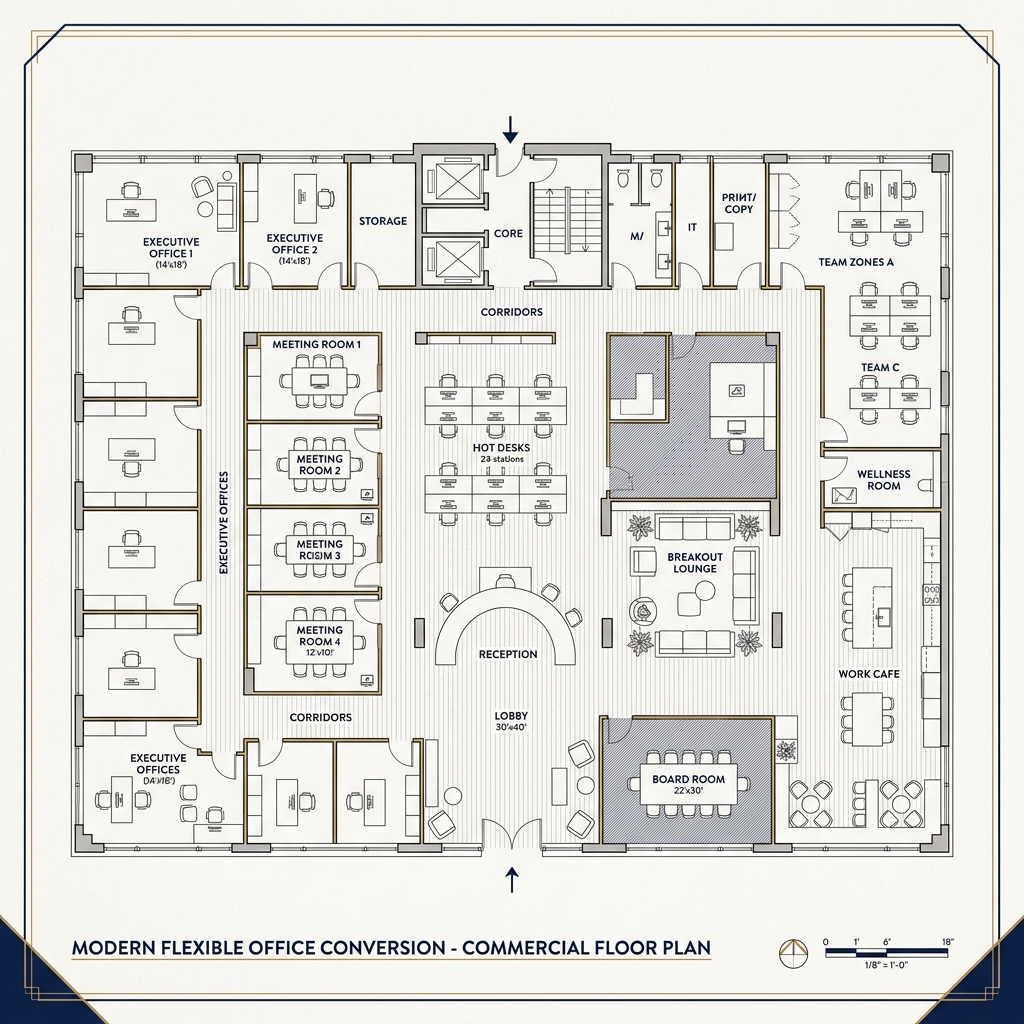
By studying high-performance floor plans, landlords can design layouts that maximize rentable spatial efficiency. Organizing the physical layout of the conversion space achieves multiple spatial objectives:
- Centralized Amenities: Place reception, community hubs, café seating, and bathrooms in the core to optimize common infrastructure.
- Outer Perimeter Suites: Position executive private offices and team suites along the exterior windows to capture natural light and command premium desk rates.
- Shared Collaboration Zones: Zone hot desk benches, brainstorm pods, and focus nooks as transitional buffers to control sound and movement.
The Five Strategic Pillars of Private Office Mix Conversion
Successful office conversions rely on a structured underwriting approach to define the physical layout. When properly executed, the product mix is guided by five strategic pillars:
Designing for Acoustic Isolation and Privacy
A frequent error during conversion is underestimating acoustic details. Enterprise occupants will not rent private offices if thin partitions allow adjacent conversations to bleed through. To command premium office suites pricing, developers must focus on strategic design choices:
This includes deploying double-glazed glass storefront systems, extending drywall partitions to the deck above rather than stopping at the acoustical drop ceiling, incorporating sound-masking pink noise systems, and building dedicated phone booths to pull loud calls out of collaborative workspaces. When these features are integrated, they protect workspace privacy and establish the asset as a premium business location.
Evaluating the Submarket Demographics
Before selecting partition systems or final planning, landlords must perform local research to calibrate their space mix:
- Local Industry Segments: Do local companies lean toward professional services (requiring high acoustic isolation and glass suites) or creative technologies (preferring collaborative team layouts)?
- Average Team Size: What is the median office requirement (2-4 desk rooms, 6-8 desk suites, or 12+ desk enterprise wings) within the submarket?
- Pricing Cap Calibration: What is the maximum local desk membership threshold before corporate occupiers prefer to lease standard commercial space?
- Shared Amenity Capacity: How many bookable hourly boardrooms are required to support the private suite population without creating scheduling friction?
Frequently asked questions
Why is open coworking so difficult to monetize for landlords?
Open coworking requires high occupant volume to cover administrative cost, carries high transactional costs, and has short customer lifetime value. It serves primarily as a marketing gateway and building amenity, while private office suites carry the core NOI of the asset.
What partition systems are recommended for modular suites?
We recommend demountable aluminum and double-glazed glass architectural partition systems. While the upfront CapEx is higher than traditional drywall, they permit rapid layout adjustments without demolition, preserve long-term building flexibility, and qualify for accelerated depreciation schedules.
How much spatial footprint should be dedicated to amenities?
Typically, 15% of the Net Rentable Area should be dedicated to shared amenities, including phone booths, boardrooms, a welcoming cafe reception lobby, and print stations. This shared overhead is shared across all suite occupants, keeping individual office layouts highly efficient.
Members & Margins
The people and the business of the coworking model.
Ideas, stories and research for anyone who wants to understand both the members in the room and the margins that keep it open. Free.