
Your portal, and what your engagement covers
Every engagement arrives on a private portal rather than as an attachment. This guide covers what the Flex Intelligence Portal holds, how access works, what each engagement shape includes, and what a study covers. Use the contents to jump straight to a question.
Your portal
Every engagement is delivered on a private web surface rather than as an attachment, alongside the working Google Sheet. The Flex Intelligence Portal carries the modules of your engagement as interactive pages, and the questions below cover what is in it, how it is reached, and what happens to it when the numbers move.
What is the Flex Intelligence Portal?
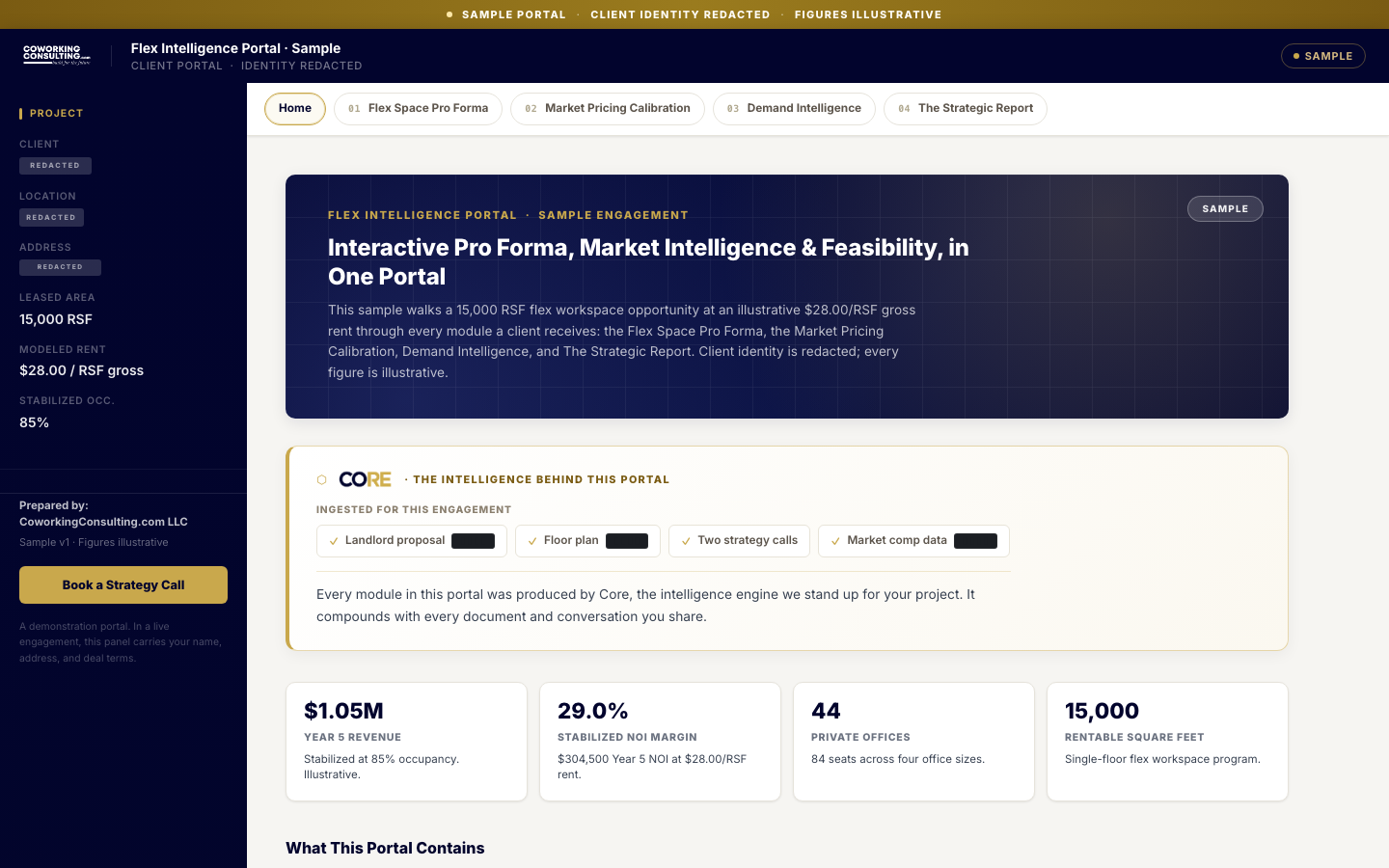
It is the private web surface each engagement is delivered through, rather than a document attached to an email. It carries the modules of the engagement as interactive pages: the pro forma with its charts and tables, the pricing evidence, the demand analysis, and the strategic report where those are included. A redacted sample of it is published so the format can be seen before anything is commissioned.
What modules can a portal contain?
Four. The Flex Space Pro Forma is the five year model plus the delivered Google Sheet. Market Pricing Calibration is the confidence rated local rate recommendation for every product in the program. Demand Intelligence covers the trade area, the demographic base, and the competitive field. The Strategic Report is the capstone document that compiles the others into a recommendation. Which modules are present depends on the scope of the engagement, and the scope is stated in the proposal.
Which cells in the spreadsheet am I meant to change?
The blue ones. Blue marks an input that is yours to move, such as stabilized occupancy, offices sold per month, pre-opening offices sold, the annual price increase, and the free rent period. Black marks a figure the model derives from those inputs, so it updates on its own. Changing a blue cell and watching the black ones respond is how the model is stress tested, and it is also the reason the working sheet is delivered rather than only a report.
What is in the delivered Google Sheet?
The rent roll with every unit type, its count and its rate; the space allocation model showing how the floor plate divides into sellable and amenity space; the five year projection with the revenue build, the full operating expense stack, and net operating income; the sixty month ramp with the monthly occupancy path and the sales targets underneath it; and a disclaimer tab stating the basis and sources. Expense lines carry short notes explaining what each one covers and where the figure comes from.
What is the difference between the portal and the spreadsheet?
The portal presents the intelligence; the Google Sheet is the same model in the standard five year spreadsheet format that operators and lenders expect, including the full sixty month ramp, the rent roll, and the space allocation model. Both are delivered and both stay in sync, because both are produced from the same engine. The portal is where the story is read, the sheet is where the formulas are interrogated.
How does access to a portal work?
Each portal sits at its own address and opens with an access code, checked at the server before any file is served, so the pages, the floor plans, and any documents beside them are all covered by the same gate. Codes are chosen to be memorable rather than random, so they survive the email they arrived in. The sample portal opens with the code SAMPLE.
Does portal access expire?
The gate is a standing access code rather than a timed link, so a portal does not close on a schedule. If a code needs to be changed or a portal needs to be retired, that is done on request.
What happens to the portal when the numbers change?
The spreadsheet is the single source of truth, so a change is made there and the portal is resynced to it across every surface that carries the figure: the headline tiles, the profit and loss table, the charts, and the narrative. A portal carrying a number the sheet no longer holds is treated as a defect, not a version.
Is the portal updated after a review call?
Yes. A review is expected to change things, and revised inputs flow through the model and back into the portal, which is versioned so it is always clear which revision is being read. That is the reason the work is delivered on a live surface rather than as a fixed attachment.
Why are the sample portal figures illustrative?
Because the sample describes a hypothetical 15,000 rentable square foot workspace rather than any real property, client, or engagement. The client identity is redacted and the figures are model outputs for demonstration. The structure, the modules, and the way evidence is presented are exactly what a client receives; only the subject is masked.
How is pricing shown inside the portal?
Each product in the program carries a recommended monthly rate, the band of real competitor pricing behind it, the number of comparables that band rests on, and a plain confidence rating. The recommended rate is the exact rate the pro forma runs on, so the model and the pricing evidence never disagree. Where the data is thin, the confidence rating says so rather than hiding it.
The engagement shapes
The work is organized as four modules that nest into three shapes. Each contains the modules of the one inside it rather than replacing them, so nothing is rebuilt when an engagement goes further.
What is the difference between a pro forma and a full feasibility study?
A pro forma establishes what the building produces: the model, the local rates it runs on, and a clear read of the market around it. A Full Feasibility Study takes every one of those further rather than adding a chapter to the end. The financial work, the pricing work, and the market work are each carried to a greater depth, demand is validated in its own right, and the whole thing resolves into a recommendation. It is a step change in depth across the study, not the pro forma with a section appended.
What does demand validation add that the financial model does not?
The model answers what the space produces at a given occupancy. Demand Intelligence answers whether that occupancy is actually available in this specific market. It works the trade area, the demographic base, the local office market, and the competitive field, and it reaches a stated verdict with the confidence level attached to each part of the evidence. Those are genuinely different questions, and a strong model in a market that cannot fill the space is a precise answer to the wrong one.
What is The Strategic Report?
It is the capstone document of the Full Feasibility Study. It compiles the market case, the pricing strategy, the occupancy ramp, the space program, the financial story, the staffing plan, and the risks into one narrative with a recommendation, and it is built to be read by lenders, investors, brokers, and partners as well as by the owner. It is also produced as a paginated document for printing and circulation.
Can a pro forma engagement be extended into a fuller study later?
Yes. Because the layers nest rather than replace each other, the model, the pricing work, and the portal built for a Flex Space Pro Forma carry forward into a fuller study rather than being rebuilt. Beginning with one layer does not close the others off, and how an extension is structured is worked out directly rather than set by a formula.
What a study covers
A study is anchored to one address and one floor plate, and the market work is built on the catchment around it. Knowing that shape makes it straightforward to say at the start how many properties and which markets are in play.
What geography does a study cover?
A study is anchored to one subject address. Demand work is built on the catchment around it, typically a five mile ring for the core trade area with a wider ten to fifteen mile lens for regional depth, along with the operators, feeder communities, and office market evidence inside that footprint. A different market has its own catchment, its own competitive field, and its own demographic base, so it is analyzed in its own right rather than read off the first one.
Does the model cover one site, or can it compare several?
A model is built for one property, because the rent roll, the allocation, and the lease economics are all specific to that floor plate. Comparing sites is a real and common question, and the way it is answered is by modeling each property and setting the results beside each other. Comparison engagements are scoped that way from the start, so it is worth saying up front how many properties are in play.
What counts as a revision, and what is a new model?
Moving an input inside an existing model is a revision: a different rent rate, a changed abatement, a new office mix on the same plan, updated rates. Those flow through the model and back into the portal, and they are expected. A different building, a different market, or a different floor plate is a new model, because the test fit, the rent roll, the local pricing, and the trade area all change together. The distinction is about how much of the model is being rebuilt rather than how large the change feels.
What happens if the property or the space changes after the model is built?
If it is the same building and the plan or the terms have moved, the inputs are updated and the results flow through. If the deal has moved to a different property, that is a new subject and it is modeled as one. Either way the earlier work is not wasted: the calibrated engine, the local pricing research, and the market read all carry forward.
How long does a model stay useful?
The engine and the structure hold. What ages is the evidence attached to the deal: lease terms that were still being negotiated, local competitor rates, and the market conditions behind the demand read. A model is most reliable while the lease terms it was built on are still the live ones, and refreshing local pricing is the usual way of bringing an older model current.
Keep going
Want a portal for your own building?
Bring the address, the floorplate, and the lease terms. What comes back is a model built on those specifics, delivered on a portal of your own.
Book a Strategy Call